
AI in Construction: How AI is Changing Construction Management
Construction management is becoming more complex as developers face rising costs, tighter schedules, labour constraints, and increasing expectations for quality and accountability. In Toronto, where residential, commercial, and mixed-use developments require coordination among multiple stakeholders, managing every detail efficiently can be a significant challenge.
Artificial intelligence (AI) is emerging as a valuable tool for addressing some of these challenges. From predicting potential project delays to analyzing construction schedules and improving safety monitoring, AI in construction is changing how project teams plan, manage, and deliver buildings.
However, adopting AI is not simply about introducing new software. Its real value lies in helping construction professionals make better-informed decisions, identify risks earlier, and use project information more effectively.
For developers, contractors, and construction managers, understanding these applications can reveal practical opportunities to improve project performance. By combining AI with experienced professionals, reliable data, and established management processes, construction businesses can work toward more predictable and efficient project delivery.

What Is AI in Construction?
Artificial intelligence in construction refers to the use of computer systems that analyze information, identify patterns, generate predictions, or assist with decisions throughout the construction process.
Unlike traditional software that follows predefined instructions, some AI systems can learn from data, recognize complex patterns, and generate recommendations based on available information.
In construction management, AI can support activities such as:
Project scheduling and progress forecasting
Cost estimation and budget monitoring
Risk identification and mitigation
Construction site safety monitoring
Design coordination and document analysis
Equipment maintenance and resource planning
Quality control and defect detection
AI does not replace every task performed by a project manager, engineer, or contractor. Instead, it can help professionals process information more efficiently and focus their attention on decisions that require experience and judgment.
Why AI Is Becoming Important in Toronto's Construction Industry
Construction projects involve interconnected decisions about budgets, materials, labour, schedules, design requirements, and regulatory compliance.
A delay in one area can affect several others. For example, a late material delivery may disrupt subcontractor schedules, increase equipment costs, and postpone subsequent activities.
AI tools can help project teams analyze these relationships and identify potential problems before they become more difficult or expensive to resolve.
For developers in Toronto, potential applications are particularly relevant to:
Multi-unit residential condominiums
Apartment rental developments
Commercial construction
Building conversions and refurbishments
Large projects involving multiple subcontractors
The objective is not to automate every construction activity. It is to improve visibility, coordination, and decision-making across the project lifecycle.
5 Ways AI Is Changing Construction Management
1. Predicting Delays and Improving Project Scheduling
Traditional project schedules establish when activities should happen and how they depend on one another. However, actual construction progress can be affected by weather, labour availability, design changes, equipment issues, and delayed deliveries.
AI-powered scheduling tools can analyze historical project information, current progress, and other available data to identify patterns associated with delays.
Depending on the quality of the data and the capabilities of the software, these systems may help project managers:
Identify activities at risk of falling behind
Recognize dependencies that could affect the critical path
Compare planned progress with actual performance
Evaluate alternative scheduling scenarios
Prioritize activities requiring immediate attention
For example, if a residential project is experiencing repeated delays in receiving key materials, an AI-assisted system may help identify the pattern and highlight activities that could be affected.
The project manager can then coordinate with suppliers and subcontractors to explore alternatives before the delay spreads throughout the schedule.
AI predictions are not guarantees. They should be reviewed alongside site conditions, professional judgment, and verified project information.

2. Improving Cost Estimation and Budget Control
Cost overruns remain a major concern for developers and construction managers. Changes in material prices, labour requirements, design specifications, and project duration can all affect the final budget.
AI can support cost management by analyzing historical project costs, current estimates, procurement information, and changes in project scope.
Potential applications include:
Identifying unusual cost variations
Comparing estimated costs with actual expenditure
Forecasting potential budget pressures
Reviewing quantities and procurement records
Highlighting changes that may affect the overall budget
Consider a multi-unit residential development where the cost of certain materials increases unexpectedly. An AI-assisted analysis could help the team identify affected budget categories and assess the potential impact on the project forecast.
The construction manager can then review purchasing options, investigate alternatives, or revise the forecast.
AI-generated estimates still depend on reliable inputs. They should not replace professional quantity surveying, supplier quotations, contract reviews, or appropriate contingency planning.

3. Strengthening Construction Site Safety
Construction sites involve hazards associated with working at heights, moving equipment, lifting operations, and interactions between workers and machinery.
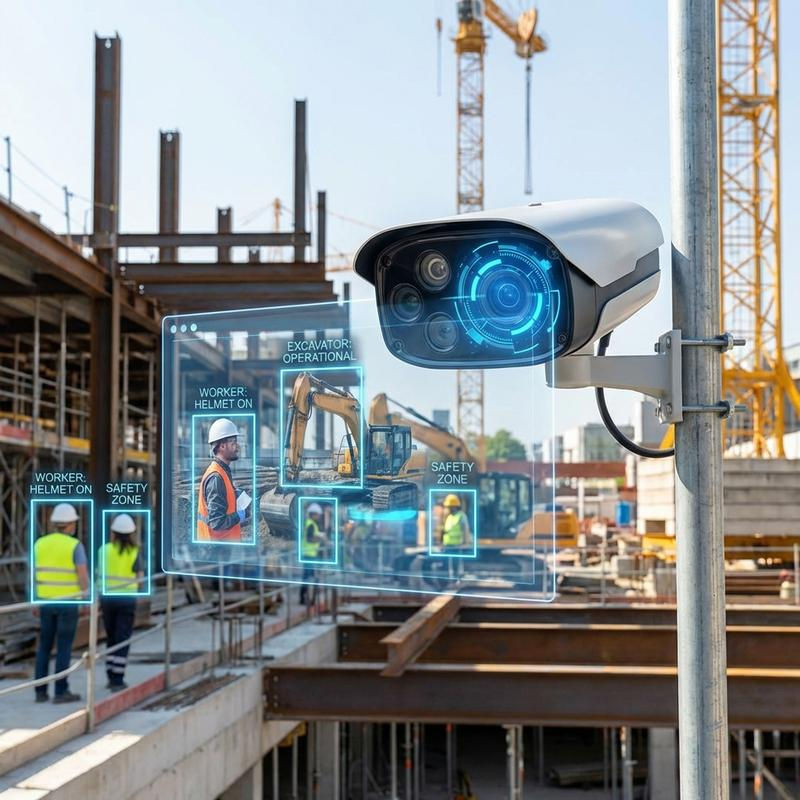
AI-enabled computer vision systems can analyze images or video feeds to identify certain conditions that may require attention. Depending on the system, these applications may include detecting restricted-area access, identifying missing personal protective equipment, or recognizing potentially unsafe interactions.
AI can also help teams review incident records and identify recurring patterns that may inform safety planning.
For example, if site reports repeatedly identify congestion around material delivery areas, management can review access routes, delivery timing, and separation between workers and equipment.
However, AI-based monitoring can produce false alerts or miss hazards. It should complement, not replace, trained safety personnel, site inspections, worker training, and established occupational health and safety procedures.
Privacy, appropriate data handling, and applicable workplace requirements must also be considered when introducing monitoring technologies.
4. Enhancing Design Coordination and Quality Control
Construction errors can be expensive, especially when they are discovered after installation or when completed work must be removed to accommodate a design change.
AI can assist with design reviews, document analysis, image-based progress monitoring, and identifying discrepancies in certain project records.
When combined with Building Information Modeling (BIM), digital drawings, and coordinated project information, AI-assisted tools may help teams identify inconsistencies or flag areas requiring further review.
For example, an AI-enabled document review system could highlight differences between versions of project specifications or identify missing information that needs clarification.
On site, image analysis tools may help identify visible defects or compare recorded progress against planned work.
These tools do not automatically establish that a building complies with every design or code requirement. Qualified professionals must verify important findings, and formal inspections remain essential.

5. Making Project Communication More Efficient
Construction management generates substantial amounts of documentation, including meeting minutes, requests for information (RFIs), submittals, site reports, schedules, and change orders.
When information is spread across emails, spreadsheets, document folders, and separate software platforms, important decisions can be difficult to track.
AI tools can help summarize documents, extract key information, organize project records, and identify outstanding actions.
For example, an AI assistant may summarize a project meeting and produce a draft list of decisions, responsibilities, and deadlines for review.
This can reduce administrative effort and help teams follow up on outstanding issues.
However, summaries and extracted information should be checked for accuracy. Confidential project information should only be processed through tools approved for the organization's security and privacy requirements.
Practical Steps for Introducing AI Into Construction Management
Adopting AI does not require a construction company to transform every process at once. A focused approach can help establish value while limiting unnecessary disruption.
Start With a Specific Problem
Identify a recurring challenge before selecting a technology.
Examples include delayed reporting, inconsistent cost forecasts, difficulty tracking RFIs, or limited visibility into schedule risks.
A clearly defined problem makes it easier to determine whether AI is appropriate and how success should be measured.
Improve Data Quality
AI systems depend on the information available to them. Inconsistent schedules, outdated drawings, incomplete cost records, and poorly maintained project documentation can produce unreliable results.
Establish clear procedures for recording, updating, and verifying project information before relying on AI-generated recommendations.
Choose Tools That Fit Existing Workflows
AI should support the way project teams work rather than introduce unnecessary complexity.
Construction management platforms, BIM tools, document management systems, and site monitoring solutions may offer different AI capabilities.
Before selecting a tool, assess its compatibility with existing systems, ease of use, data security, integration requirements, and total cost.
Train Teams and Maintain Human Oversight
Project managers, site supervisors, and other professionals need to understand what an AI tool can do, where it may fail, and when its recommendations require additional review.
Important decisions involving safety, structural integrity, contractual obligations, compliance, and significant financial commitments should remain subject to appropriate professional oversight.
Measure the Results
Evaluate whether the technology improves a measurable aspect of project performance.
Possible indicators include:
Time required to prepare progress reports
Frequency of schedule updates
Accuracy of cost forecasts
Number of overdue project actions
Time required to review documentation
Frequency of rework or recurring defects
Establish a baseline before implementation and compare results over a suitable period. This helps distinguish genuine improvements from expectations that have not been demonstrated.
Challenges and Limitations of AI in Construction
Although AI offers promising applications, implementation comes with practical considerations.
Data quality: Incomplete or inconsistent information can undermine predictions and recommendations.
Implementation costs: Software subscriptions, integrations, training, and ongoing support can require meaningful investment.
Workforce adoption: Teams may need time to adapt their processes and develop confidence in new systems.
Privacy and cybersecurity: Project records, client information, employee data, and commercially sensitive documents must be handled appropriately.
Reliability and accountability: AI can generate incorrect information or overlook important context. Responsibilities for reviewing and acting on its outputs must remain clear.
The most effective approach is to introduce AI where its benefits can be evaluated, establish safeguards, and expand its use as the organization develops the necessary skills and processes.
How AI Fits Into Modern Construction Management at Fusioncorp
For a development and construction management firm such as Fusioncorp, technology is most useful when it supports the fundamentals of successful project delivery: planning, coordination, cost control, quality management, and communication.
Fusioncorp specializes in multi-unit residential condominiums, apartment rentals, building conversions, refurbishments and restorations, and commercial construction.
Across these project types, AI-assisted tools may offer opportunities to improve schedule analysis, organize documentation, support cost forecasting, and provide better visibility into project progress.
The appropriate application depends on each project's requirements, available data, and existing systems. AI should be considered as part of a broader management approach rather than a standalone solution.
Combining technology with experienced professionals and established construction processes can help project teams evaluate risks earlier, coordinate stakeholders more effectively, and make better-informed decisions throughout the building process.

The Future of AI in Construction Management
As AI capabilities develop, construction teams may gain access to more advanced forecasting, automated document analysis, digital site monitoring, and integrated project information.
AI may also work alongside digital twins, BIM, robotics, and other construction technologies to help professionals understand how design decisions, site conditions, and project activities interact.
Nevertheless, successful adoption will depend on more than access to advanced software. Reliable data, workforce training, cybersecurity, responsible implementation, and professional judgment will remain essential.
For Toronto developers, the opportunity is to identify where these tools can solve real operational problems and deliver measurable improvements.
Conclusion
AI in construction is changing how project teams approach scheduling, budgeting, safety, quality control, and communication. By analyzing project information and identifying patterns, AI-assisted tools can help construction managers recognize risks earlier and make more informed decisions.
However, AI is not a substitute for experienced professionals, reliable project data, or established construction management practices. Its effectiveness depends on choosing appropriate applications, verifying outputs, and maintaining clear accountability.
For developers in Toronto, a practical starting point is to identify one recurring project challenge, evaluate suitable tools, and measure the results before expanding their use.
When implemented thoughtfully, AI can become a valuable part of a more efficient, coordinated, and data-informed approach to construction management. Explore how effective planning and modern project management practices can support your next development with Fusioncorp.


Comments